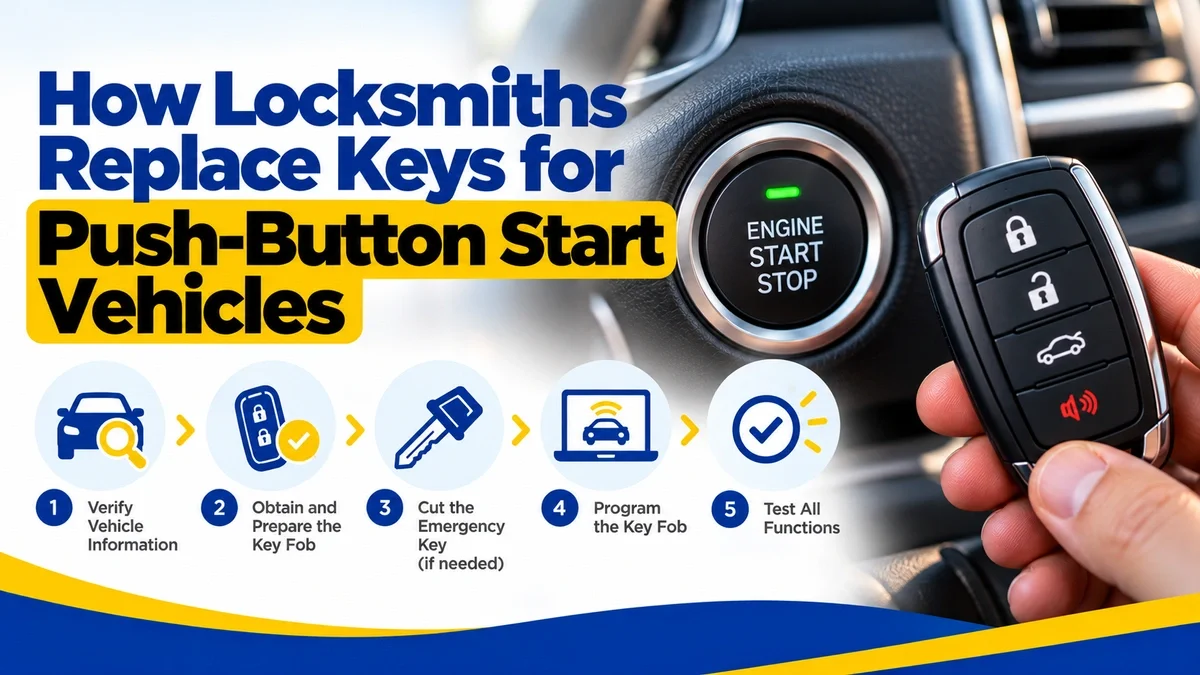
A locksmith can replace a key for many push-button start vehicles by identifying the correct compatible smart key, programming that credential to the vehicle's security system, cutting an emergency mechanical key when applicable, and testing the remote, proximity, and starting functions. Unlike a traditional metal key, a push-to-start key must usually be recognized electronically before the vehicle will authorize starting.
NHTSA explains that keyless ignition systems use an electronic key fob in place of a conventional ignition key and verify the correct device electronically when the driver attempts to start the vehicle.
That means replacing a push-to-start key is not simply a matter of copying its physical shape.
Summary
- Push-button start vehicles typically use an electronic smart key or proximity fob.
- The replacement credential must be compatible with the specific vehicle.
- Many vehicles require the new key to be electronically programmed or registered before it can start the engine.
- The vehicle's immobilizer or related security system helps verify whether the key is authorized.
- Some smart keys also contain an emergency mechanical blade that may need to be cut separately.
- Replacing a key when no working key remains can involve a different process from adding a spare.
- A key can sometimes operate one function but fail another if programming or compatibility is incomplete.
- The final step should include testing remote entry, passive detection, starting, and any mechanical emergency-key function that applies to the vehicle.
Best Way to Replace a Push-to-Start Car Key
The best approach is to treat the replacement as both an electronic credential and, in some vehicles, a mechanical key.
A professional replacement process generally involves:
- Identifying the exact vehicle
- Confirming authorization to create the key
- Identifying a compatible replacement smart key
- Programming or registering the electronic credential
- Cutting the emergency mechanical blade when applicable
- Testing all supported functions
The exact process varies by make, model, model year, and security system.
"With a push-button start vehicle, the replacement key has to do more than fit. The vehicle also has to recognize and authorize the electronic credential before normal starting can occur." - KeyMe Locksmiths
What Is a Push-to-Start Key?
A push-to-start key is usually a smart key, proximity key, or key fob that communicates electronically with the vehicle.
Instead of inserting a metal key into an ignition cylinder, the driver typically keeps the authorized fob nearby and starts the vehicle with a button.
NHTSA describes keyless ignition systems as using a device carried by the driver that takes over the functions of a traditional metal key. The vehicle electronically verifies the device when the driver attempts to start it.
Depending on the vehicle, the same credential may support:
- Remote locking and unlocking
- Passive entry
- Trunk or hatch release
- Push-button starting
- Immobilizer authorization
- Emergency mechanical entry
Those functions are related, but they are not necessarily identical.
Why Push-to-Start Keys Need Programming
A physical key works primarily because its shape matches the lock.
A push-to-start credential also has to be recognized electronically.
NHTSA notes that immobilizing anti-theft systems may use computer chips in keys to prevent unauthorized engine operation.
That means a replacement smart key can be physically compatible with the vehicle and still fail to start it if the electronic credential has not been properly authorized.
Depending on the vehicle, programming may involve communication among:
- Smart key
- Vehicle receiver
- Body-control system
- Immobilizer
- Engine-control system
- Other security modules
The exact architecture varies by manufacturer.
For a deeper explanation of that process, see How Car Key Programming Works.
Need a Locksmith? We're here to help
Connect with a trusted local locksmith for fast, professional assistance when you need it most.
Step 1: Identify the Vehicle Correctly
Push-to-start keys are vehicle-specific.
A locksmith may need information such as:
- Year
- Make
- Model
- Trim or configuration
- VIN
- Existing key type
- Whether a working key remains
This helps determine which replacement credential is compatible with the vehicle.
Two fobs can look almost identical while using different:
- Electronics
- Frequencies
- Part numbers
- Security protocols
- Programming procedures
Appearance alone is not enough to confirm compatibility.
Step 2: Confirm Authorization
Before creating or programming a replacement automotive key, the service provider may need to confirm that the person requesting the work is authorized to access the vehicle.
Useful documentation can include:
- Photo identification
- Vehicle registration
- Title or ownership documentation
- Other vehicle-specific records
The exact requirements can vary.
This step is especially important when no working key remains because the replacement credential may restore both entry and engine-start authorization.
Step 3: Identify the Correct Smart Key
The next step is selecting a compatible electronic credential.
Depending on the vehicle, that may be described as:
- Smart key
- Proximity key
- Key fob
- Intelligent key
- Remote key
- Passive-entry key
The replacement must match the vehicle's system requirements.
A wrong or incompatible fob may:
- Fail to program
- Unlock remotely but not start the vehicle
- Start the vehicle but lack other functions
- Work inconsistently
- Not communicate with the vehicle at all
That is why smart-key replacement begins with compatibility rather than simply finding a fob with the same exterior shape.
Step 4: Program the Replacement Key to the Vehicle
For many push-button start vehicles, the replacement credential must be electronically registered with the vehicle.
At a high level, this process allows the vehicle to recognize the new key as authorized.
NHTSA describes immobilizer-type systems as preventing unauthorized starting when the correct coded key is not present.
Manufacturer technical documentation also shows that smart-key systems can perform multiple layers of electronic validation before allowing starting. For example, Kia technical material distinguishes traditional transponder immobilizers from newer smart-key systems used with push-button start.
The exact programming procedure varies widely by vehicle.
That is why programming should be treated as a vehicle-specific process rather than a universal sequence.
Step 5: Cut the Emergency Mechanical Key When Applicable
Many smart keys include a small mechanical key blade.
Its purpose can vary by vehicle, but it may provide manual access when electronic entry is unavailable.
If the replacement fob includes an emergency blade, that blade may need to be cut to match the vehicle's mechanical lock.
This mechanical step is separate from electronic programming.
A smart key can therefore require both:
- A correctly cut blade
- A correctly programmed electronic credential
Completing one does not automatically complete the other.
Step 6: Test the Replacement Key
Programming should not be considered complete until the supported functions have been tested.
Depending on the vehicle, that can include:
- Remote lock
- Remote unlock
- Trunk or hatch release
- Passive entry
- Key detection
- Push-button starting
- Engine shutdown recognition
- Emergency mechanical entry
Testing matters because modern smart keys can perform several separate functions.
A key that starts the vehicle but does not unlock remotely may have a different problem from one that unlocks the doors but is rejected by the immobilizer.
How Does the Immobilizer Affect Push-to-Start Key Replacement?
An immobilizer helps prevent normal engine operation when an authorized electronic credential is not recognized.
NHTSA identifies immobilizers as anti-theft systems that can prevent thieves from bypassing the ignition and starting the vehicle.
This is why push-to-start replacement is fundamentally different from making a traditional metal duplicate.
A valid replacement may need to satisfy both:
- Physical access requirements
- Electronic security requirements
For more detail on vehicle authentication, see How Car Immobilizer Systems Work.
Can a Locksmith Replace a Push-to-Start Key Without the Original?
For many supported vehicles, replacement may still be possible even when the original smart key is unavailable.
However, an all-keys-lost situation can involve a different workflow from simply adding another key while a working credential remains.
The vehicle may need to be identified and accessed before a new credential can be registered.
The exact process depends on:
- Vehicle security system
- Model year
- Supported programming method
- Whether a working credential remains
- Replacement-key compatibility
If your immediate problem is that none of your vehicle keys can be found, see Lost Your Car Keys? for the broader decision process before replacement.
Is Replacing a Spare Different From Replacing the Only Key?
Potentially.
If one working key remains, the vehicle is already accessible and an authorized credential is available for comparison.
When every programmed key is gone, additional steps may be required to establish access and register a replacement.
Vehicle manufacturers also differ in how they handle adding keys, deleting credentials, and all-keys-lost situations.
That is why the first question during replacement is often:
Do you still have a working key?
What Happens to a Lost Push-to-Start Key?
Replacing a lost key does not always mean the missing credential automatically stops working.
Depending on the vehicle and programming capability, previously registered keys may sometimes be removed or disabled from the vehicle's authorized key list.
This is especially relevant when a smart key is:
- Stolen
- Lost in an unknown location
- Believed to be in someone else's possession
The exact capability varies by vehicle and security system, so it should not be assumed that every lost key can be electronically removed in the same way.
If there is a security concern, ask specifically whether the missing credential can remain authorized after replacement.
Why Can a Replacement Key Unlock the Car but Not Start It?
Modern keys can perform multiple jobs.
A replacement may successfully operate:
- Mechanical door lock
- Remote lock/unlock
while still failing engine-start authorization.
That can happen when:
- Transponder or smart-key credential is not properly programmed
- Replacement key is incompatible
- Immobilizer does not recognize the credential
- Vehicle security communication is incomplete
- Only some functions have been configured successfully
NHTSA's guidance on keyless ignition confirms that starting depends on electronic verification of the correct device, not simply possession of a physically compatible key.
Find a KeyMe Kiosk Near You
Need a spare key fast? Find a KeyMe kiosk near you to copy many house, office, and eligible car keys in just minutes.
Why Can a Replacement Key Start the Vehicle but Have Non-Working Buttons?
The opposite can also occur.
If the vehicle starts but remote buttons do not function correctly, the starting credential may be authorized while the remote-entry function has a separate issue.
Possible causes can involve:
- Remote programming
- Incorrect fob configuration
- Battery
- Button or circuit damage
- Vehicle receiver issue
This is why testing every supported function matters after replacement.
Do Push-to-Start Keys Still Have Transponders?
Many modern push-to-start systems perform electronic authentication that serves the same broad security purpose historically associated with transponder immobilizer systems.
The exact hardware and architecture vary.
Kia technical documentation, for example, distinguishes older transponder-based immobilizer systems from newer Smart Key Systems, while noting that smart-key systems generally include immobilizer functionality.
So it is better to think in terms of electronic vehicle authentication rather than assuming every push-to-start system uses the exact same transponder design.
Is Push-to-Start Key Replacement the Same for Every Vehicle?
No.
NHTSA explicitly notes that keyless ignition systems differ among vehicle models.
Differences can include:
- Smart-key architecture
- Programming requirements
- Number of vehicle modules involved
- Emergency-start procedure
- Key detection system
- Fob design
- Mechanical backup key
- Security authorization process
Vehicle-specific documentation and compatible service equipment matter.
Can You Buy a Replacement Fob Before Programming It?
A replacement fob must be compatible with the vehicle before programming can succeed.
A fob that looks correct may not necessarily be electronically compatible.
Before buying or attempting to program a replacement, confirm:
- Correct vehicle application
- Correct part or credential type
- Compatibility with the security system
- Whether the key is new or previously registered
- Whether the vehicle supports the intended programming method
Buying the wrong credential can leave you with a fob that cannot be successfully authorized.
Can a Used Smart Key Be Reprogrammed?
Possibly, but this is highly vehicle- and key-specific.
Some used credentials may be reusable under certain conditions, while others may remain associated with a previous vehicle or require procedures that are not supported.
Do not assume that a secondhand fob can always be reset and programmed to another vehicle.
Compatibility should be confirmed before relying on a used smart key as a replacement.
What If the Vehicle Says “Key Not Detected” After Replacement?
If a newly programmed key produces a Key Not Detected warning, possible areas to investigate include:
- Programming
- Key compatibility
- Fob battery
- Vehicle receiver
- Smart-key communication
- Vehicle battery
- Security-system fault
A recognition problem after replacement should not automatically be treated as a failed key.
For the dedicated diagnostic process, see Key Not Detected Warning: Causes and Fixes.
Can a Weak Fob Battery Prevent Programming?
A weak or incorrectly installed fob battery can interfere with normal wireless operation, but programming requirements vary by vehicle.
If the fob behaves inconsistently, verify that the correct battery is installed and functioning normally before assuming the replacement credential or vehicle is defective.
Battery problems should be separated from credential-authorization problems because they are not the same failure.
When Should You Use a Locksmith for Push-to-Start Key Replacement?
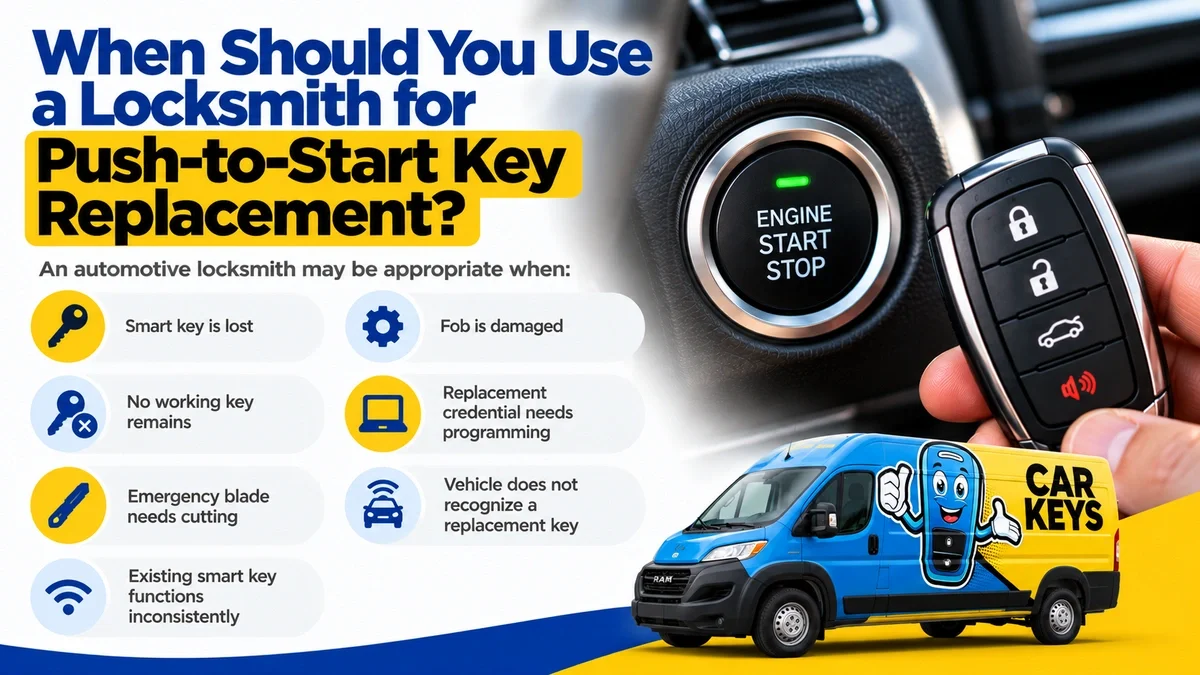
An automotive locksmith may be appropriate when:
- Smart key is lost
- Fob is damaged
- No working key remains
- Replacement credential needs programming
- Emergency blade needs cutting
- Vehicle does not recognize a replacement key
- Existing smart key functions inconsistently
For supported vehicles, KeyMe provides car key replacement and car key programming services.
Copy Your Key from Anywhere - Right from Your Phone
Skip the kiosk and copy your key from home. Upload a clear photo of an eligible house or car key, and KeyMe will create a precise duplicate and mail it directly to your door.
How KeyMe Can Help
KeyMe supports automotive key replacement and programming for many vehicle makes and models.
Depending on the vehicle and key type, service may involve:
- Identifying the compatible replacement credential
- Programming the key
- Cutting a mechanical blade when applicable
- Testing supported functions
The exact process depends on the vehicle.
How Locksmiths Replace Keys for Push-Button Start Vehicles: The Bottom Line
Replacing a push-to-start key is not simply a matter of cutting another key.
A successful replacement may require:
- Identifying the exact vehicle
- Confirming authorization
- Selecting a compatible smart key
- Programming the electronic credential
- Cutting an emergency blade when applicable
- Testing every supported function
The most important difference from a traditional mechanical key is electronic authorization.
NHTSA explains that keyless ignition systems electronically verify the correct device before normal starting, while immobilizer systems are designed to prevent engine operation without an authorized key.
That is why compatibility, programming, immobilizer recognition, and final testing all matter when replacing a modern push-to-start key.
References
- National Highway Traffic Safety Administration. Keyless Ignition Systems. Explains how keyless ignition systems use an electronic fob and verify the correct device before allowing vehicle starting.
https://www.nhtsa.gov/driver-assistance-technologies/keyless-ignition-systems - National Highway Traffic Safety Administration. Vehicle Theft Prevention. Explains immobilizing anti-theft devices, including systems that use computer chips or electronic credentials to prevent unauthorized engine operation.
https://www.nhtsa.gov/vehicle-safety/vehicle-theft-prevention - Kia Technical Times. Immobilizer vs. Smart Key. Manufacturer technical material explaining the distinction between traditional transponder immobilizers and Smart Key Systems used with push-button start vehicles.
https://static.nhtsa.gov/odi/tsbs/2014/SB-10072336-2280.pdf - KeyMe Locksmiths. How Car Key Programming Works. Explanation of how replacement automotive credentials are electronically paired with supported vehicles.
https://key.me/article/how-car-key-programming-works - KeyMe Locksmiths. How Car Immobilizer Systems Work. Explanation of the relationship between authorized keys, vehicle security systems, and engine-start authorization.
https://key.me/article/how-car-immobilizer-systems-work - KeyMe Locksmiths. Lost Your Car Keys? Guidance on the broader decision process when one or all vehicle keys are missing.
https://key.me/article/lost-your-car-keys - KeyMe Locksmiths. Key Not Detected Warning: Causes and Fixes. Troubleshooting guidance for smart-key recognition and communication problems.
https://key.me/article/key-not-detected-warning-causes-and-fixes