

After you request emergency lockout service, the locksmith service process generally moves through several stages: collecting information about the lockout, confirming authorization, evaluating the door or vehicle, determining an appropriate method for restoring access, completing the service, and identifying any additional lock or key problem that still needs attention.
Not every lockout appointment follows exactly the same sequence.
A house key locked safely inside is different from a broken key lodged in a cylinder. A vehicle with its working key on the seat is different from an all-keys-lost situation. A commercial lockout can also involve additional authorization or access-control considerations.
Understanding those differences can help you know what to expect after requesting professional assistance.
If you have not requested service yet and are still deciding what to do, start with What to Do When You're Locked Out.
Summary
- The service provider will need basic information about the location and type of lockout.
- Be clear about whether the key is locked inside, lost, broken, or malfunctioning.
- A locksmith may need to confirm that you are authorized to access the home, vehicle, or business.
- Once onsite, the technician evaluates the opening and relevant hardware before deciding how to proceed.
- The method used depends on the lock, door, vehicle, hardware condition, and circumstances.
- Do not assume every lockout requires drilling or lock replacement.
- Restoring entry may be the end of the service when a working key was simply locked inside.
- Lost keys, broken keys, damaged locks, or malfunctioning hardware may create additional service needs.
- Ask what work was performed and whether existing keys or credentials still operate before the service is complete.
- If additional work is recommended, understand whether it involves repair, rekeying, replacement, extraction, or key replacement.
Step 1: You Provide Details About the Lockout
The service process starts before the locksmith evaluates the lock.
You may be asked for information such as:
- Location
- Home, business, or vehicle
- Door or opening involved
- Whether the key is locked inside
- Whether the key is lost
- Whether a key has broken
- Whether the lock is malfunctioning
- Vehicle year, make, and model where relevant
- Any unusual access conditions
Accurate information helps distinguish a basic lockout from a situation that may involve a different service.
For example:
Working key locked inside a vehicle: Primarily an access problem.
Only vehicle key lost: Potential access plus car key replacement.
House key broken in cylinder: Potential access plus broken key extraction.
Door lock mechanically failing: Potential access plus lock repair.
"A lockout describes the immediate problem, but it doesn't always describe the complete service need. Knowing whether the key is inside, lost, broken, or no longer operating the hardware helps the locksmith understand what needs to be evaluated." - KeyMe Locksmiths
Step 2: Authorization May Need to Be Confirmed
A professional locksmith should not provide access to a home, vehicle, or business without considering whether the person requesting service is authorized to enter.
Depending on the circumstances, verification may involve appropriate identification or documentation.
The exact process can vary based on:
- Type of property
- Vehicle
- Available identification
- Ownership or occupancy circumstances
- Business authorization
This step protects both the property and the person requesting service.
If you know you'll need professional lockout assistance, have relevant identification or documentation available when possible.
For a more detailed explanation, see Understanding Locksmith Service Authorization.
Need a Locksmith? We're here to help
Connect with a trusted local locksmith for fast, professional assistance when you need it most.
Step 3: The Locksmith Evaluates the Opening
Once onsite, the technician needs to understand the actual opening before deciding how to proceed.
For a residential or commercial door, that may involve evaluating:
- Lock type
- Cylinder
- Deadbolt
- Latch
- Door
- Frame
- Existing hardware condition
- Visible damage
For a vehicle, relevant factors may include:
- Year
- Make
- Model
- Door and locking system
- Key location
- Key type
- Whether the key is lost or merely inside
This evaluation matters because there is no single entry method appropriate for every lockout.
Step 4: The Locksmith Determines an Appropriate Entry Method
The technician selects an approach based on the hardware, opening, and circumstances.
The goal is to restore authorized access while avoiding unnecessary damage where possible.
The exact method varies.
Factors can include:
- Lock construction
- Hardware condition
- Door configuration
- Vehicle design
- Whether the key is available
- Whether the lock itself has failed
Consumers should be cautious about assuming that one particular technique should always be used.
A conventional residential cylinder, smart lock, commercial door, and modern vehicle can require very different approaches.
Does Every Lockout Require Drilling the Lock?
No.
Drilling is not an automatic part of every lockout.
Whether destructive entry is appropriate depends on the lock, hardware condition, circumstances, and available methods.
Likewise, it would be inaccurate to promise that every opening can always be accessed without affecting the hardware.
A locksmith should evaluate the situation before determining an appropriate approach.
If you have questions about the proposed work, ask before it begins.
Step 5: Authorized Access Is Restored
In a straightforward lockout, restoring access may resolve the entire problem.
Consider a homeowner whose functioning key is sitting on the kitchen counter.
Once authorized access is restored:
- The key is recovered.
- The lock still works.
- No key is missing.
- No hardware has failed.
Additional lock work may not be necessary.
The same can be true when a working vehicle key is safely locked inside a car.
But other lockouts reveal an additional problem.
Step 6: The Locksmith Determines Whether Anything Else Needs Attention
After entry, the original cause of the lockout still matters.
If the Key Was Simply Locked Inside
There may be nothing else to correct.
If the Key Was Lost
The question becomes whether future access should change.
For a home, rekeying may be worth considering depending on the circumstances and hardware.
For a vehicle, a lost key may require car key replacement and, for supported vehicles, car key programming.
If the Key Broke
The remaining fragment may require broken key extraction.
The key and lock should also be evaluated to determine whether resistance or hardware condition contributed to the break.
If the Lock Malfunctioned
The hardware may need lock repair.
If the Lock Is Damaged or Unsuitable
Lock replacement may be discussed.
These are separate services with different purposes.
Step 7: Additional Work Should Be Explained
Restoring entry does not automatically authorize unrelated work.
If additional service is recommended, understand:
- What problem was found
- Which component is affected
- Whether the proposed work is repair, rekeying, replacement, extraction, or key replacement
- Whether the existing hardware will remain
- Whether existing keys will still operate afterward
For more on evaluating locksmith service before work begins, see Questions to Ask Before Locksmith Work Begins.
What Happens During a Home Lockout?
A residential lockout typically centers on a specific exterior opening.
The locksmith may evaluate:
- Lock
- Keyway
- Deadbolt
- Latch
- Door condition
- Frame
- Evidence of a mechanical problem
If the lock functions normally and the key was simply left inside, the service may focus solely on restoring authorized entry.
If the key was lost, broken, or the hardware malfunctioned, the conversation may expand to another service.
KeyMe provides home lockout service and residential locksmith services for supported needs.
What Happens During a Car Lockout?
Automotive lockouts require vehicle-specific evaluation.
The locksmith may need:
- Vehicle year
- Make
- Model
- Location of the key
- Type of key
- Whether another working key exists
If the functioning key is locked inside, the service may end after access is restored and the key is recovered.
If the key has been lost, the situation can become a replacement-key service.
Modern vehicles may use:
- Traditional mechanical keys
- Transponder keys
- Remote-head keys
- Smart or proximity keys
Some replacement keys require electronic programming before the vehicle will authorize them.
KeyMe provides car lockout service, car locksmith services, car key replacement, and car key programming for supported vehicles.
Find a KeyMe Kiosk Near You
Need a spare key fast? Find a KeyMe kiosk near you to copy many house, office, and eligible car keys in just minutes.
What Happens During a Business Lockout?
Commercial lockouts can involve additional authorization and hardware considerations.
The locksmith may need to determine:
- Who is authorized to request entry
- Whether building management controls the opening
- Type of commercial hardware
- Whether an access-control system is involved
- Whether the lock has mechanically failed
A business opening may contain hardware that differs substantially from a typical residential door.
KeyMe offers commercial lockout service and commercial locksmith services for supported properties.
For additional context, see Locked Out of Your Office? Here's What You Need to Know.
What If the Locksmith Finds a Broken Key?
If part of a key remains in the cylinder, removing it may be necessary before the lock can be properly evaluated.
Extraction should be performed without pushing the fragment farther into the keyway.
Afterward, consider why the key broke.
Possible contributing factors can include:
- Key wear
- Bent key
- Excessive force
- Cylinder resistance
- Door alignment
KeyMe offers broken key extraction.
For a deeper explanation, see How Locksmiths Extract Broken Keys Safely.
What If the Locksmith Finds a Mechanical Problem?
A lockout can sometimes be the first obvious sign of a developing hardware problem.
Examples might include:
- Cylinder malfunction
- Deadbolt binding
- Latch problem
- Damaged hardware
That does not automatically mean the entire lock needs replacement.
Depending on the diagnosis, lock repair may be appropriate.
If the hardware is damaged or otherwise unsuitable for continued service, replacement may be considered.
For a detailed comparison, see Rekeying vs. Replacing Your Locks.
What Should You Confirm Before the Service Is Complete?
Once access has been restored, make sure you understand the condition of the opening.
Depending on what work was performed, useful questions include:
- Does my existing key still work?
- Was the lock changed?
- Was the cylinder rekeyed?
- Do my previous keys still operate it?
- Was any hardware replaced?
- Does the door lock and unlock normally?
- Is another repair recommended?
- Was a broken key fully removed?
- Does a replacement vehicle key require additional programming?
- Is there anything about the hardware I should monitor?
This is especially important when the service involved more than simply opening a functioning lock.
Copy Your Key from Anywhere - Right from Your Phone
Skip the kiosk and copy your key from home. Upload a clear photo of an eligible house or car key, and KeyMe will create a precise duplicate and mail it directly to your door.
What Should You Expect From Professional Locksmith Service?
Professional standards matter because lockout work involves access to homes, vehicles, and businesses.
ALOA's consumer resources encourage consumers to work with qualified locksmith professionals and understand the services being performed.
Before work proceeds, you should understand the basic problem being addressed and the proposed service.
For a broader consumer guide, see What Professional Locksmith Standards Should Customers Expect?.
You can also review What to Expect When You Book a Locksmith Through KeyMe Locksmiths for KeyMe-specific booking information.
Best Way to Prepare for Emergency Lockout Service
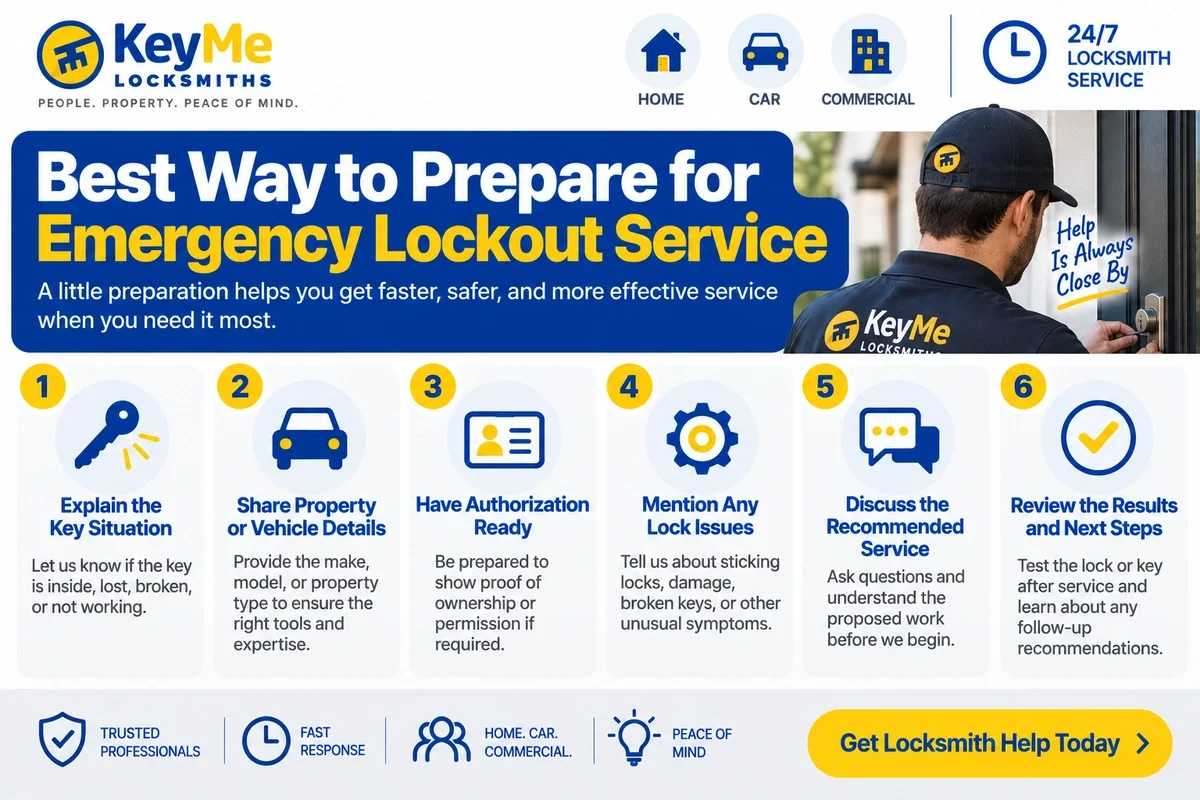
Once you have decided professional assistance is necessary:
1. Explain What Happened to the Key
Inside, lost, broken, or malfunctioning are meaningfully different situations.
2. Provide Accurate Property or Vehicle Information
That helps clarify the type of opening involved.
3. Have Authorization Information Available
Be prepared to demonstrate legitimate access where required.
4. Describe Any Hardware Problems
Mention sticking, damage, broken keys, or other unusual symptoms.
5. Ask About Proposed Work
Understand what service is being recommended before additional work begins.
6. Test the Opening After Service
Confirm that the door, lock, key, or replacement key operates as expected based on the completed work.
7. Understand Any Follow-Up Recommendation
Know whether the locksmith is recommending repair, rekeying, replacement, extraction, or another service and why.
"The end of a lockout appointment should leave you understanding more than whether the door opened. You should also know what caused the access problem, what work was performed, and whether anything about the key or hardware still needs attention." - KeyMe Locksmiths
A Lockout Service Is More Than Opening a Door
The exact service depends on why access was lost.
Working key locked inside: Restoring entry may resolve the situation.
Lost house key: Entry may be followed by an access-control decision.
Broken key: Extraction and hardware evaluation may be necessary.
Failed lock: Repair or replacement may need to be considered.
Lost vehicle key: Replacement and programming may become part of the service.
That is why emergency lockout service begins with information gathering and evaluation rather than assuming every locked door requires the same solution.
KeyMe offers emergency locksmith services, home lockout service, car lockout service, commercial lockout service, and related locksmith services for supported needs.
If you have not yet requested professional help and are still evaluating your immediate options, start with What to Do When You're Locked Out.
References
- Associated Locksmiths of America (ALOA). Consumer Information. Consumer resources covering locksmith selection and professional locksmith services.
https://www.aloa.org/consumers - Associated Locksmiths of America (ALOA). What Is a Locksmith? Background on the professional scope of locksmith work and security hardware services.
https://www.aloa.org/ - National Highway Traffic Safety Administration (NHTSA). Vehicle Theft Prevention. Federal consumer information relevant to vehicle keys and access security.
https://www.nhtsa.gov/vehicle-safety/vehicle-theft-prevention