

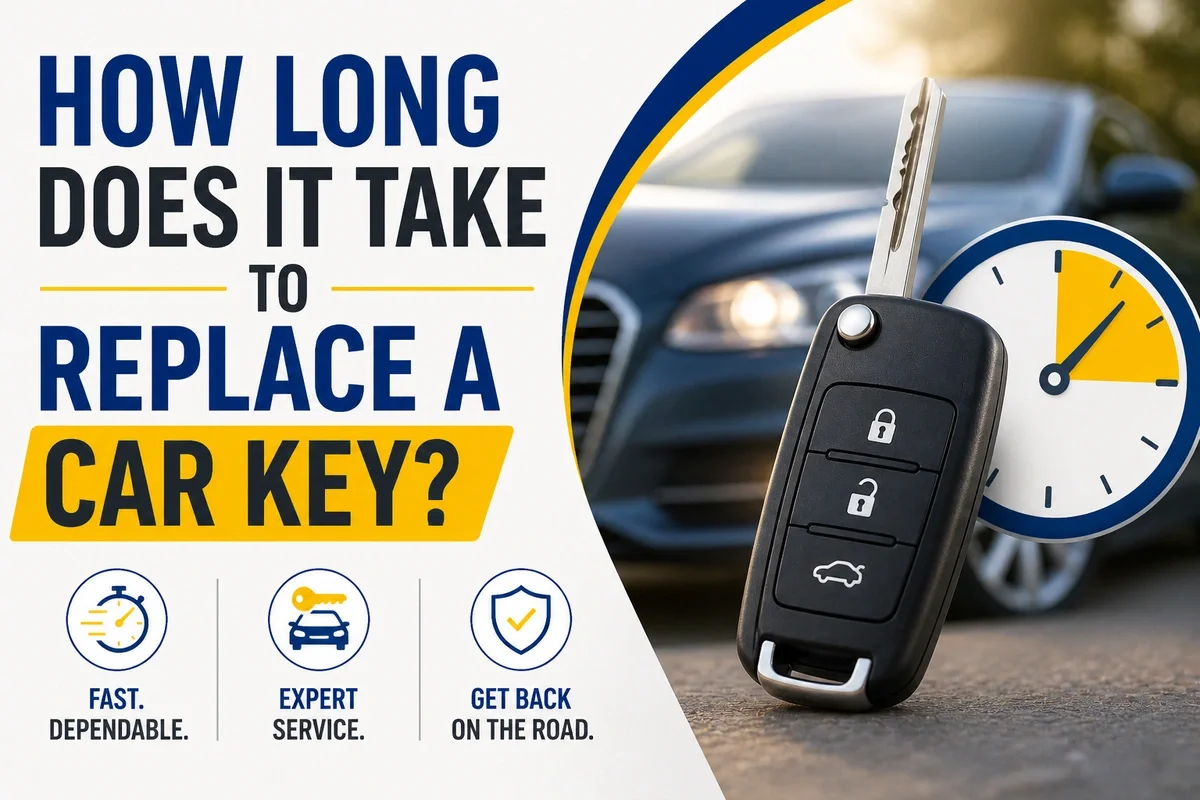
How long it takes to replace a car key depends on the vehicle, key system, availability of the correct replacement key, whether another working key exists, and what needs to happen before the new key can be tested and used.
A replacement can involve several separate steps: identifying the correct key, verifying vehicle information and ownership, obtaining the compatible key or fob, cutting a mechanical blade when applicable, completing vehicle-specific electronic setup when required, and testing the finished key.
The actual service portion is only one part of the timeline. Scheduling, key availability, vehicle location, access to the vehicle, and whether additional diagnosis is required can all affect how quickly the replacement process is completed.
If your main question is what makes one replacement more expensive or complex than another, see How Much Does It Cost to Replace a Car Key?.
Summary
- There is no single replacement time that applies to every car key.
- Identifying the correct year, make, model, and key system is one of the first steps.
- The correct replacement key or fob needs to be available before the job can be completed.
- Mechanical cutting may be required for keys that include a physical blade.
- Modern electronic keys may require vehicle-specific programming or registration.
- Having another working key can change the replacement workflow for some vehicles.
- An all-keys-lost situation may involve additional procedures.
- Vehicle location, technician availability, dealership scheduling, and parts availability can affect the overall timeline.
- Additional diagnosis may be necessary if the vehicle does not recognize an otherwise compatible replacement key.
- Preparing the VIN, vehicle details, proof of ownership, and information about existing keys before requesting service can reduce avoidable delays.
Best Way to Reduce Car Key Replacement Delays
The most useful thing you can do is provide accurate vehicle and key information before service begins.
Have the following ready when possible:
- Vehicle year
- Make
- Model
- VIN
- Current vehicle location
- Proof of ownership or other documentation requested by the provider
- Whether you have any working keys
- Whether the vehicle uses a traditional ignition or push-button start
- What happened to the original key
- Whether the vehicle is currently accessible
This information helps the provider determine what key system the vehicle uses and what may be needed to complete the replacement.
"Car key replacement time is not just about cutting a key. The provider first has to identify the correct vehicle and credential, determine what equipment or key is needed, complete the required physical and electronic work, and verify that the finished key operates as intended." - KeyMe Locksmiths
Need a Locksmith? We're here to help
Connect with a trusted local locksmith for fast, professional assistance when you need it most.
What Actually Happens During Car Key Replacement?
Understanding the process helps explain why replacement time varies.
1. The Vehicle Is Identified
The provider first needs to determine exactly what vehicle is involved.
Important information can include:
- Year
- Make
- Model
- VIN
- Trim or configuration when relevant
- Existing key type
This matters because vehicles with similar names or appearances can use different key systems across model years or configurations.
A replacement should be matched to the vehicle's actual system rather than selected only by how the original key looked.
2. Ownership or Authorization Is Verified
Before creating a working vehicle key, a legitimate service provider may require proof that the person requesting the key is authorized to access the vehicle.
The exact requirements depend on the provider and situation.
Having identification, registration, title information, or other requested ownership documentation available can prevent this administrative step from becoming an unnecessary delay.
3. The Correct Replacement Key Is Identified
"Car key" can describe several types of credentials, including:
- Mechanical keys
- Transponder keys
- Remote-head keys
- Smart or proximity keys
This article does not need to duplicate the technology behind each one.
What matters for timing is that the provider must identify the correct compatible replacement before moving forward.
For the technology itself, see What Happens Inside a Smart Car Key?.
4. The Key or Fob Must Be Available
A provider can have the equipment to service a vehicle but still need the correct replacement key, remote, or smart fob.
Availability can therefore be one of the biggest differences between:
- A replacement that can proceed during the scheduled service
- A replacement that requires obtaining a compatible component first
Availability can depend on:
- Vehicle
- Model year
- Key type
- Provider inventory
- Specific electronic configuration
This is one reason providing vehicle information in advance is useful.
5. A Mechanical Key May Need to Be Cut
If the replacement includes a mechanical blade, that component may need to be cut to match the vehicle.
That could apply to:
- Traditional ignition keys
- Transponder keys
- Remote-head keys
- Hidden emergency blades inside some smart-key fobs
Mechanical cutting and electronic authorization are different steps.
A correctly cut blade does not automatically mean the electronic portion of a modern vehicle key is ready to use.
6. Electronic Setup May Be Required
Modern keys can require an electronic procedure before the vehicle recognizes them.
From a timing perspective, the important point is simply that this creates another step in the replacement workflow.
The procedure varies significantly by vehicle.
For the actual programming process, see How Car Key Programming Works.
Keeping the deeper programming explanation there helps this page stay focused on how programming affects the overall replacement timeline.
7. The New Key Is Tested
Replacement is not complete simply because a physical key has been cut or an electronic credential has been added.
Depending on the key and vehicle, testing may include:
- Mechanical door access
- Ignition operation
- Vehicle starting
- Lock button
- Unlock button
- Trunk or hatch function
- Proximity recognition
- Push-button-start recognition
If one expected function does not work, the provider may need to determine whether the issue involves the new key, programming, vehicle, or another component.
That can extend the process beyond the initial replacement steps.
Does Having a Working Key Make Replacement Faster?
It can change the workflow.
There is an important difference between:
You Still Have One Working Key
The provider can identify the existing credential and may have a working reference available during service.
You Have No Working Keys
This is generally called an all-keys-lost situation.
Depending on the vehicle, all-keys-lost service may require a different electronic procedure or additional vehicle-specific steps.
This article focuses only on how that distinction can affect the workflow.
If you have just discovered that all of your keys are missing, the immediate response belongs in Lost Your Car Keys? What to Do Next.
What Can Make Car Key Replacement Take Longer?
Several issues can extend the timeline without having anything to do with the physical act of cutting a key.
The Correct Key Is Not Immediately Available
A compatible replacement credential may need to be obtained before the job can proceed.
Vehicle Information Is Incomplete
Incorrect model-year or key information can make it harder to identify the proper replacement.
Providing the VIN can help confirm vehicle details.
For a deeper explanation of VIN-based replacement, see Can You Replace a Car Key by VIN Number Online?.
No Working Key Exists
All-keys-lost situations can require a different workflow from adding or replacing a key when another credential remains available.
The Vehicle Cannot Be Accessed Normally
The provider may first need to determine how the vehicle can be serviced if:
- It is locked
- It cannot be moved
- It is parked somewhere difficult to access
- Vehicle power or another condition affects service
A car lockout itself is a separate service need. See car lockout service.
Additional Diagnosis Is Needed
Replacement can become a diagnostic problem if:
- A compatible key will not register
- Vehicle electronics are not responding normally
- Another existing key shows similar problems
- The replacement works mechanically but not electronically
- The vehicle produces an unexpected warning
If the primary symptom is Key Not Detected, that troubleshooting intent belongs in Key Not Detected Warning: Causes and Fixes.
Scheduling or Service Availability Changes
The total elapsed time also depends on when appropriate service is available.
The actual key work may represent only one portion of the time between discovering the problem and having a functioning replacement.
Locksmith vs. Dealership: How the Workflow Can Differ
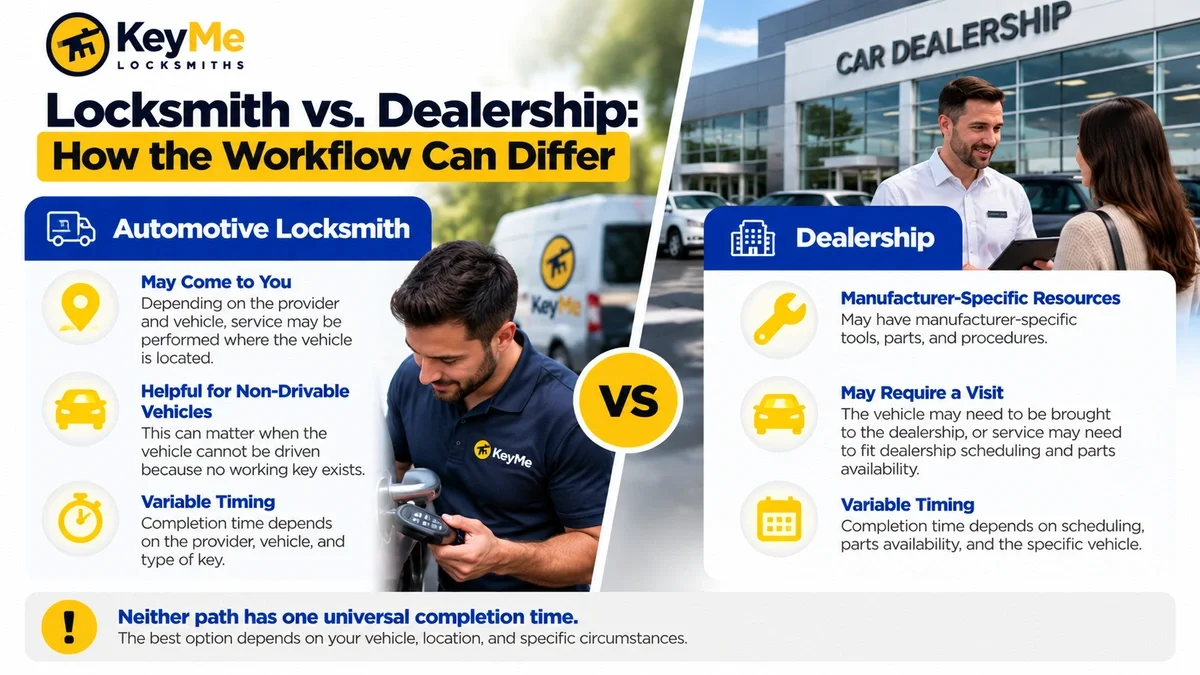
Both automotive locksmiths and dealerships may provide replacement services for supported vehicles, but the logistics can differ.
Automotive Locksmith
Depending on the provider and vehicle, service may be performed where the vehicle is located.
This can matter when the vehicle cannot be driven because no working key exists.
Dealership
A dealership may have manufacturer-specific tools, parts, and procedures, but the vehicle may need to be brought to the dealership or service may need to fit dealership scheduling and parts availability.
Neither path has one universal completion time.
The relevant questions are:
- Can this provider service my exact vehicle?
- Is the correct key available?
- Does the vehicle need to be brought somewhere?
- What documentation is required?
- Does the provider have the equipment needed for the vehicle's key system?
Can a Car Key Be Replaced in One Service Visit?
For some supported vehicles and situations, the physical and electronic replacement steps may be completed within one service visit when the correct key, equipment, vehicle access, and required information are available.
That should not be treated as a universal promise.
Additional steps may be needed when:
- The required key is unavailable
- Vehicle-specific equipment is needed
- Documentation is incomplete
- All keys are lost
- Electronic diagnosis is required
- The vehicle has another underlying problem
It is more useful to ask a provider whether they support your specific vehicle than to assume every replacement follows the same timeline.
Find a KeyMe Kiosk Near You
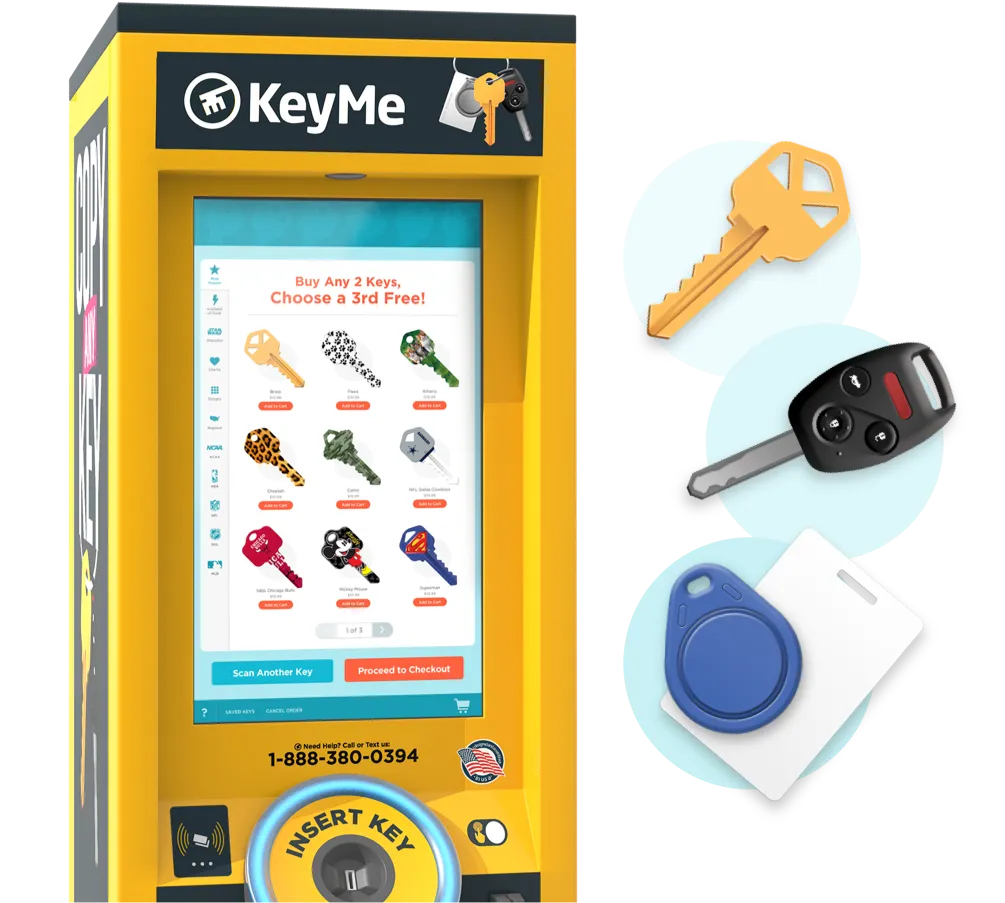
Need a spare key fast? Find a KeyMe kiosk near you to copy many house, office, and eligible car keys in just minutes.
What Information Should You Provide Before Scheduling?
Providing complete information up front can help the provider plan the job.
Useful details include:
Vehicle
- Year
- Make
- Model
- VIN
Key Situation
- At least one working key available
- No working keys
- Key physically damaged
- Key missing
- Fob present but blade missing
- Mechanical key works but electronic function does not
Vehicle Location
Explain where the vehicle is and whether it can currently be moved.
Documentation
Ask what proof of ownership or authorization will be required.
Current Symptoms
Be specific.
For example:
- "I lost every key."
- "I have one working key and need another."
- "The physical key works but the vehicle doesn't recognize the fob."
- "The vehicle is locked and I have no key."
Those situations can involve very different workflows.
Replacement and Duplication Have Different Timelines
Replacing a missing or unusable credential is not always the same as creating an additional copy while a working key is available.
Duplication
The customer already has a working credential and wants another supported key.
Replacement
A missing, damaged, or unusable credential needs to be replaced.
All Keys Lost
No functioning key is available.
These situations should not be treated interchangeably.
For questions about whether a kiosk is appropriate when you still have a supported working key, see Is It Safe to Use a Self-Service Kiosk for Car Key Duplication?.
Where KeyMe Car Key Vans Fit In
For supported vehicles, KeyMe Car Key Vans provide in-person automotive key duplication and programming at participating retail locations.
This option is most relevant when you can plan service around a scheduled location rather than needing an emergency response to an immobilized vehicle.
You can check participating locations and schedules here:
Find a KeyMe Car Key Van Near You
Vehicle support varies, so identify your vehicle before relying on a particular service path.
What If the Replacement Key Works Differently Than Expected?
A replacement process may require further evaluation if:
- Mechanical blade works but electronic functions do not
- Vehicle recognizes one key but not another
- Remote buttons work but the vehicle does not authorize starting
- More than one replacement credential fails
- Vehicle continues to display a recognition warning
Those cases are no longer simply questions of how long key replacement takes.
They become diagnostic questions.
Keeping those topics separate prevents this article from competing with KeyMe's dedicated troubleshooting content.
Copy Your Key from Anywhere - Right from Your Phone
Skip the kiosk and copy your key from home. Upload a clear photo of an eligible house or car key, and KeyMe will create a precise duplicate and mail it directly to your door.
How KeyMe Can Help With Car Key Replacement
For supported vehicles, KeyMe offers several automotive key service paths:
- Car key replacement
- Car key programming
- Automotive locksmith services
- KeyMe Car Key Vans at participating retail locations
The appropriate option depends on your vehicle, key type, location, and whether another working key remains available.
References
- AAA: Smart Keys
- NHTSA: Keyless System Interpretation
- NHTSA: Engine Immobilizer Interpretation
- KeyMe Locksmiths: How Much Does It Cost to Replace a Car Key?
- KeyMe Locksmiths: Lost Your Car Keys? What to Do Next
- KeyMe Locksmiths: How Car Key Programming Works
- KeyMe Locksmiths: Can You Replace a Car Key by VIN Number Online?
- KeyMe Locksmiths: Key Not Detected Warning: Causes and Fixes
- KeyMe Locksmiths: Is It Safe to Use a Self-Service Kiosk for Car Key Duplication?