

There is no universal schedule that requires homeowners to change their locks every few years. Instead, review your home's locks and key access when something changes, such as moving into a home, losing a key, changing who should have access, experiencing a break-in or attempted forced entry, or noticing that a lock is no longer operating normally.
In other words, think in terms of events and access changes, not an arbitrary calendar.
A lock that operates normally does not necessarily need to be replaced simply because it has reached a particular age. At the same time, a relatively new lock may deserve attention immediately if a key goes missing or someone who should no longer have access still has a copy.
Summary
- There is no single replacement interval that applies to every home's locks.
- Review your locks and key control whenever you move into a home.
- A lost or stolen key should trigger an access review.
- Review access when someone who previously had a key should no longer be able to enter.
- Inspect affected doors and hardware after a break-in or attempted forced entry.
- Changes in lock performance should trigger evaluation rather than automatic replacement.
- Renovations and changes in how a household uses the property can create new access needs.
- Smart-lock users should periodically review active users, codes, and other credentials.
- Keep track of who has authorized spare keys.
- Once you identify a reason to change access or hardware, determine whether rekeying, repair, or replacement addresses the actual problem.
Do Home Locks Need to Be Changed on a Schedule?
Not necessarily.
There is no universal rule that says every residential lock should be changed after a specific number of years.
Locks are hardware products, and their service life can vary based on:
- Hardware construction
- Frequency of use
- Installation
- Door and frame condition
- Maintenance
- Environment
- Exposure to weather
- Physical wear
ANSI/BHMA A156.39-2025 establishes performance requirements for residential locksets and latches, including durability, security, operation, and finish. ANSI/BHMA A156.40-2025 establishes requirements for residential deadbolts and deadlatches. BHMA's standards demonstrate why lock performance is better understood through hardware condition and use than a simple age threshold.
"A homeowner shouldn't think of lock changes as something that happens automatically when the calendar reaches a certain date. Access changes when people, keys, hardware, or the property itself changes. Those events are more useful triggers for reviewing your locks than an arbitrary replacement interval." - KeyMe Locksmiths
Need a Locksmith? We're here to help
Connect with a trusted local locksmith for fast, professional assistance when you need it most.
1. Review Your Locks When You Move Into a Home
Taking possession of a home is one of the clearest reasons to review its locks.
The issue is key control.
Even when the previous owner gives you several keys, you may not know whether additional copies were previously given to:
- Relatives
- Neighbors
- Contractors
- Housekeepers
- Pet sitters
- Caregivers
- Former residents
- Other authorized visitors
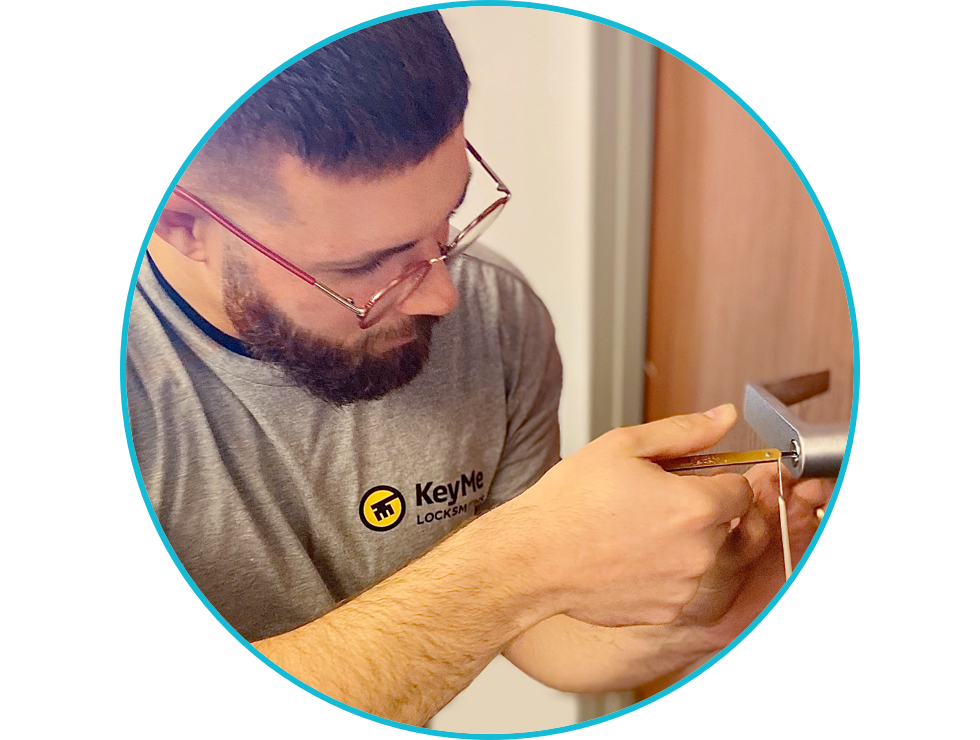
ALOA recommends changing the locks when taking possession of a house and specifically identifies rekeying as a way to establish new key control when the existing hardware is suitable. ALOA also notes that newly constructed homes can have construction-keying considerations.
For a move-in-specific process, see How Lock Rekeying Works for New Homeowners.
2. Review Access After Losing a House Key
A missing key does not always create the same level of concern.
Consider:
- Where the key was lost
- Whether it was stolen
- Whether it was attached to identification
- Whether someone could connect it to your home
- Whether other keys were lost with it
- Whether you know approximately how many copies exist
The important question is whether you remain comfortable with the key continuing to operate the home.
If not, changing authorized mechanical access may be appropriate.
See What to Do After Losing Your House Keys for the full lost-key response process.
3. Review Your Locks When Someone No Longer Needs Access
A key does not have to be lost for key control to change.
Sometimes you know exactly where another copy is: someone else has it.
Review household access when a person who previously had legitimate access should no longer have it.
Examples can include:
- Former roommate
- Previous tenant
- Contractor
- Household worker
- Caregiver
- Other person previously given a key
The key may even have been returned.
The broader question is whether additional copies could exist and whether you want the old keying to remain valid.
This is primarily an access-control trigger, not necessarily a hardware problem.
4. Inspect Locks After a Break-In or Attempted Forced Entry
A break-in or attempted forced entry should trigger an evaluation of the affected opening.
Do not look only at the cylinder.
Inspect the:
- Lock
- Deadbolt
- Latch
- Strike
- Door
- Frame
- Fasteners
- Surrounding hardware
Visible damage may require attention, but not every incident automatically means every lock throughout the home must be replaced.
The appropriate response depends on what was affected.
KeyMe provides lock repair and installation and lock replacement for supported residential situations.
5. Review a Lock When Its Performance Changes
A lock that starts behaving differently is telling you something.
Watch for changes such as:
- Key becoming harder to insert
- Key becoming harder to remove
- Increasing resistance when turning
- Deadbolt binding
- Latch failing to engage consistently
- Loose lever or knob
- Lock becoming increasingly unreliable
- Visible physical damage or corrosion
These are reasons to evaluate the opening.
They are not automatic proof that the lock must be replaced.
The key, cylinder, latch, strike, door alignment, or another part of the opening could be contributing.
For symptom-by-symptom troubleshooting, see The Most Common Home Lock Problems.
6. Review Access When Your Household Changes
Households change over time.
Someone may move in.
Someone may move out.
A caregiver may begin visiting regularly.
An older child may need independent access.
A relative may stay for an extended period.
Each change can affect who needs a key and which entrances they should be able to use.
Instead of automatically making another copy every time someone needs access, periodically step back and ask:
Who currently has keys to this home, and who should have them?
That is key control.
Find a KeyMe Kiosk Near You
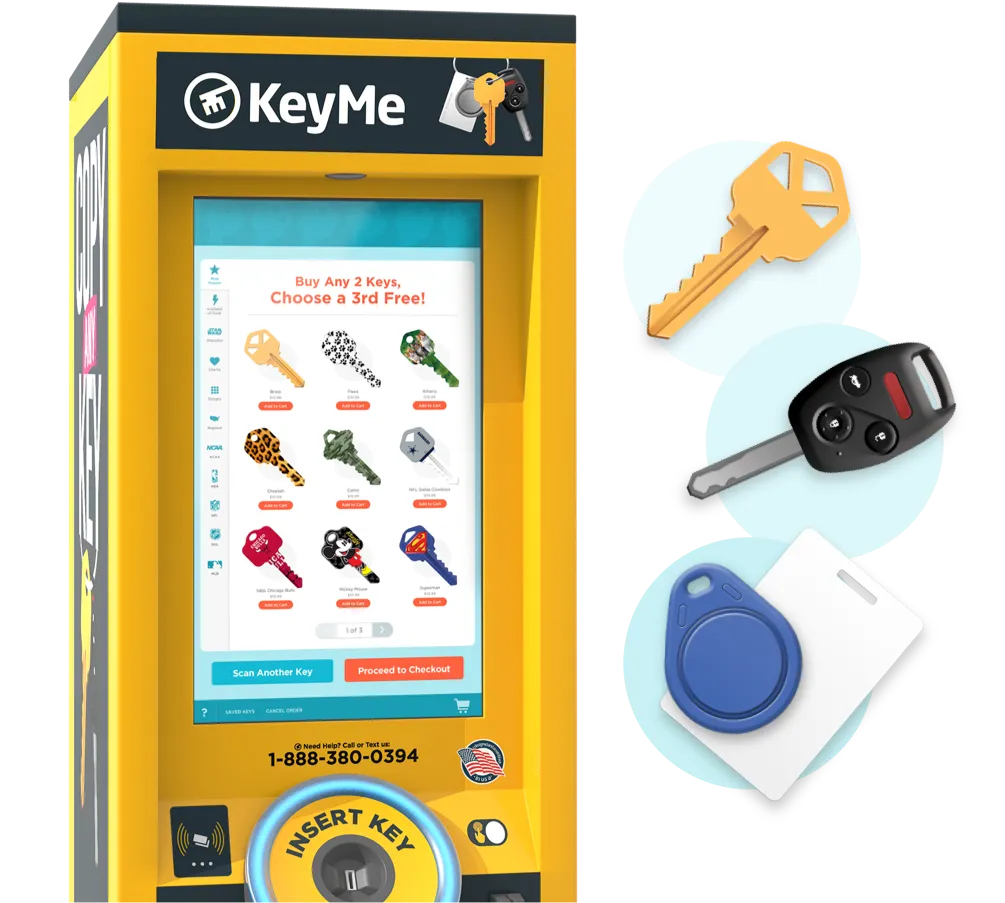
Need a spare key fast? Find a KeyMe kiosk near you to copy many house, office, and eligible car keys in just minutes.
7. Review Your Locks During or After Renovations
Renovations can affect both hardware and key control.
A project may involve:
- General contractors
- Subcontractors
- Painters
- Electricians
- Plumbers
- Cleaning crews
- Other temporary workers
It can also change the physical opening itself.
A new door, frame, addition, garage conversion, or redesigned entrance may create different hardware requirements.
Once a renovation is complete, review:
- Who received temporary keys
- Whether those keys were returned
- Which exterior openings changed
- Whether existing hardware still operates normally
- Whether your keying plan still makes sense
For more detail, see Working With a Locksmith During Renovations.
8. Review Locks When the Way You Use Your Home Changes
The property itself does not need to change ownership for its access needs to evolve.
Examples include:
- Creating a separate home office entrance
- Adding an accessory living space
- Converting a garage
- Adding an exterior door
- Beginning to rent part of the property
- Increasing use of a side or rear entrance
- Changing which entrance family members normally use
The existing hardware may still function perfectly while no longer matching the household's access needs.
That is another reason a lock review should consider both hardware condition and how access is actually used.
9. Review Access When You Want New Lock Features
Sometimes the trigger is not a problem at all.
You may want:
- Keypad access
- Electronic credentials
- Temporary access codes
- App-based management
- A different keying arrangement
That is a reason to evaluate whether your existing locks still fit your needs.
It does not mean every homeowner should replace a mechanical lock with an electronic one.
The appropriate choice depends on how the household wants to manage access.
See Smart Lock vs. Traditional Lock for a more detailed comparison.
10. Smart Locks Need Access Reviews Too
A smart lock changes the way access can be managed, but it does not eliminate the need to review who can enter.
Depending on the system, periodically check:
- Active users
- Access codes
- Temporary credentials
- App permissions
- Connected accounts
- Physical backup keys
Remove credentials that are no longer needed according to the manufacturer's procedures.
Also remember that a smart lock is still part of a physical door opening.
The door, latch, deadbolt, strike, and other hardware still need to operate properly.
11. Review Spare-Key Control
Spare keys are useful only when their location and authorization are understood.
Periodically ask:
- How many spare keys exist?
- Where are they?
- Who has them?
- Does everyone who has one still need it?
- Is any copy unaccounted for?
- Has anyone made an additional copy?
- Are there keys for detached garages or other exterior openings that should also be reviewed?
This is especially useful after years of living in the same home.
Keys tend to accumulate as households change.
12. Consider Every Exterior Opening
"Changing the house locks" often makes people think only about the front door.
A complete access review may include:
- Front door
- Back door
- Side entrance
- Garage-to-house door
- Detached garage
- Storage building
- Other keyed exterior openings
ALOA specifically advises homeowners taking possession of a property to consider garage and storage-building locks in addition to the house itself.
Different openings can have different access requirements and hardware conditions.
Copy Your Key from Anywhere - Right from Your Phone
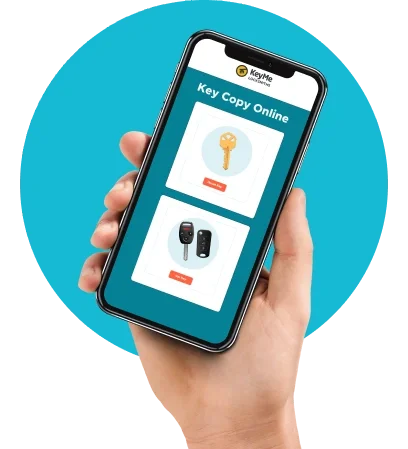
Skip the kiosk and copy your key from home. Upload a clear photo of an eligible house or car key, and KeyMe will create a precise duplicate and mail it directly to your door.
What Does "Change Your Locks" Actually Mean?
This phrase can cause confusion.
"Changing the locks" does not always mean installing entirely new hardware.
Once you identify a reason to change access or address a lock, the appropriate service could involve:
Rekeying: Changing which mechanical key operates compatible existing hardware.
Repair: Correcting a serviceable mechanical or installation problem.
Replacement: Installing different lock hardware.
Which one is appropriate depends on what you're trying to accomplish and the condition of the existing opening.
For the full service decision, see Rekeying vs. Replacing Locks.
Best Way to Review Your Home's Locks
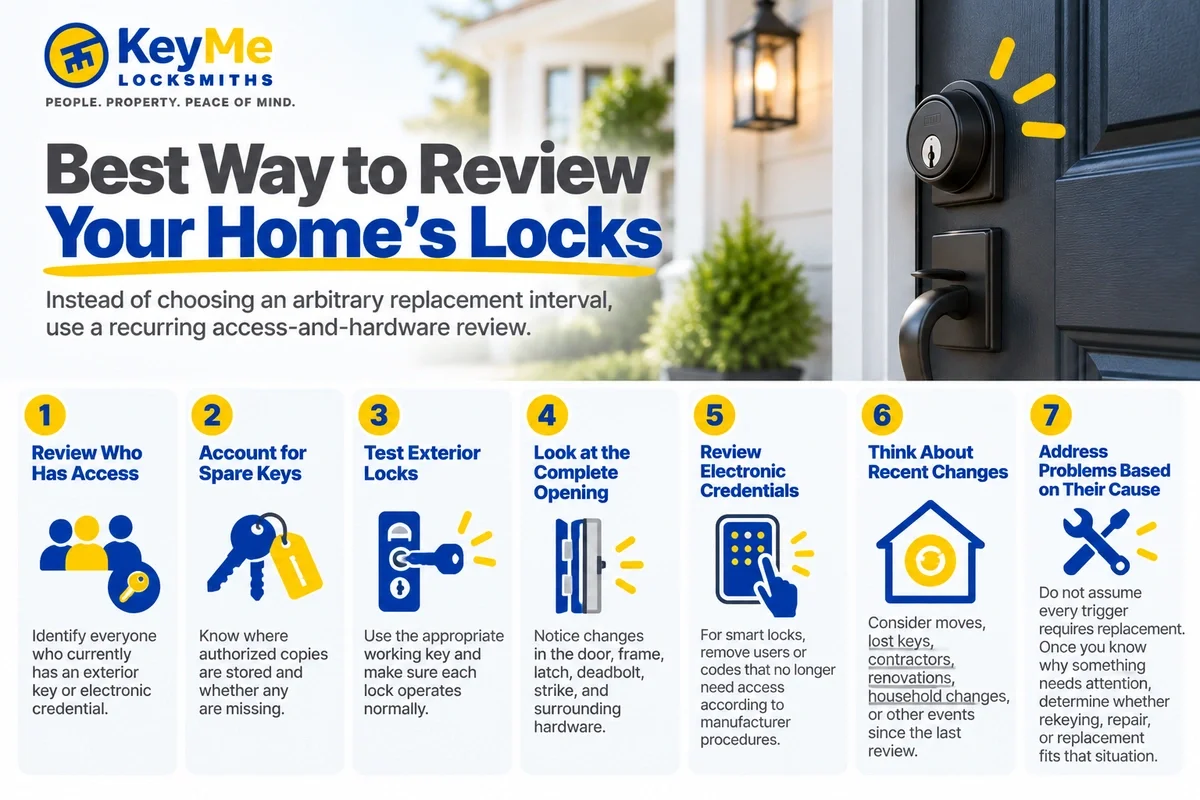
Instead of choosing an arbitrary replacement interval, use a recurring access-and-hardware review.
Review Who Has Access
Identify everyone who currently has an exterior key or electronic credential.
Account for Spare Keys
Know where authorized copies are stored and whether any are missing.
Test Exterior Locks
Use the appropriate working key and make sure each lock operates normally.
Look at the Complete Opening
Notice changes in the door, frame, latch, deadbolt, strike, and surrounding hardware.
Review Electronic Credentials
For smart locks, remove users or codes that no longer need access according to manufacturer procedures.
Think About Recent Changes
Consider moves, lost keys, contractors, renovations, household changes, or other events since the last review.
Address Problems Based on Their Cause
Do not assume every trigger requires replacement.
Once you know why something needs attention, determine whether rekeying, repair, or replacement fits that situation.
Review Access When Something Changes
The better question is not simply:
"How old are my locks?"
Ask:
Who has access?
Are all keys accounted for?
Has the household changed?
Has a key been lost or stolen?
Has the property changed?
Is the hardware still operating normally?
Those questions provide more useful reasons to act than an arbitrary replacement schedule.
KeyMe provides residential locksmith services, rekeying, lock repair and installation, and lock replacement for supported residential needs.
Once you've identified a reason for changing access or addressing hardware, see Rekeying vs. Replacing Locks to determine which type of service addresses the problem.
References
- Associated Locksmiths of America (ALOA). Should I Change My Locks When I Move Into a House? ALOA guidance on establishing key control after taking possession of a home, including rekeying existing locks when appropriate.
https://www.aloa.org/consumers/changelocks - Builders Hardware Manufacturers Association (BHMA). ANSI/BHMA A156.39-2025, Residential Locksets and Latches. Current residential lockset and latch performance requirements covering operation, durability, security, strength, and finish.
https://buildershardware.com/ANSI-BHMA-Standards/Hardware-Highlights/A15639-2025-Residential-Locksets-and-Latches - Builders Hardware Manufacturers Association (BHMA). ANSI/BHMA A156.40-2025, Residential Deadbolts. Current residential deadbolt and deadlatch performance requirements.
https://buildershardware.com/ANSI-BHMA-Standards/Hardware-Highlights/A15640-2025-Residential-Deadbolts